
ACDC Dynamic B0 Field Control — Gordon Conference Showcase
ACDC Dynamic B0 Field Control: Additional Showcase
Related Repositories:
- bughht/ACDC_Optim — Shim waveform optimization solvers
- bughht/concomitant_sim — Concomitant field simulation toolkit
1. Short-Term Eddy Current Compensation: Correcting EPI Edge Ghosts
The Problem
In single-shot EPI, rapidly switching gradient waveforms induce short-term eddy currents (decay $\tau \sim 1$–$10$ ms) in the cryostat and surrounding conductors. These eddy currents create a time-varying gradient bias during the EPI readout train that manifests as Edge ghosts superimposed on the primary image.
Traditional pre-emphasis approaches compensate eddy currents by modifying the gradient input waveform, but:
- Pre-emphasis is limited to linear ($x, y, z$) spatial corrections
- Eddy currents with short time constants are difficult to calibrate accurately
- Cross-term eddy currents ($G_x \to B_0$, $G_y \to B_0$) are often unaddressed
The ACDC Solution
The AC/DC shim array provides 31 independent $B_0$ control channels that can be modulated at the waveform level ($\sim$ kHz update rate). By solving the constrained optimization (see ACDC Optim notes):
$\min_{\mathbf{X}} \frac{1}{2}|\mathbf{C}\mathbf{X}\mathbf{W} - \mathbf{B}|F^2 \quad \text{s.t.} |X{t,c}| \le I_{\max},\sum_c |X_{t,c}| \le I_{\Sigma,\max}$
we obtain shim current waveforms $\mathbf{X}(t)$ that prospectively cancel the eddy-current-induced $B_0$ offset at every time point during the EPI readout.
Preliminary Results
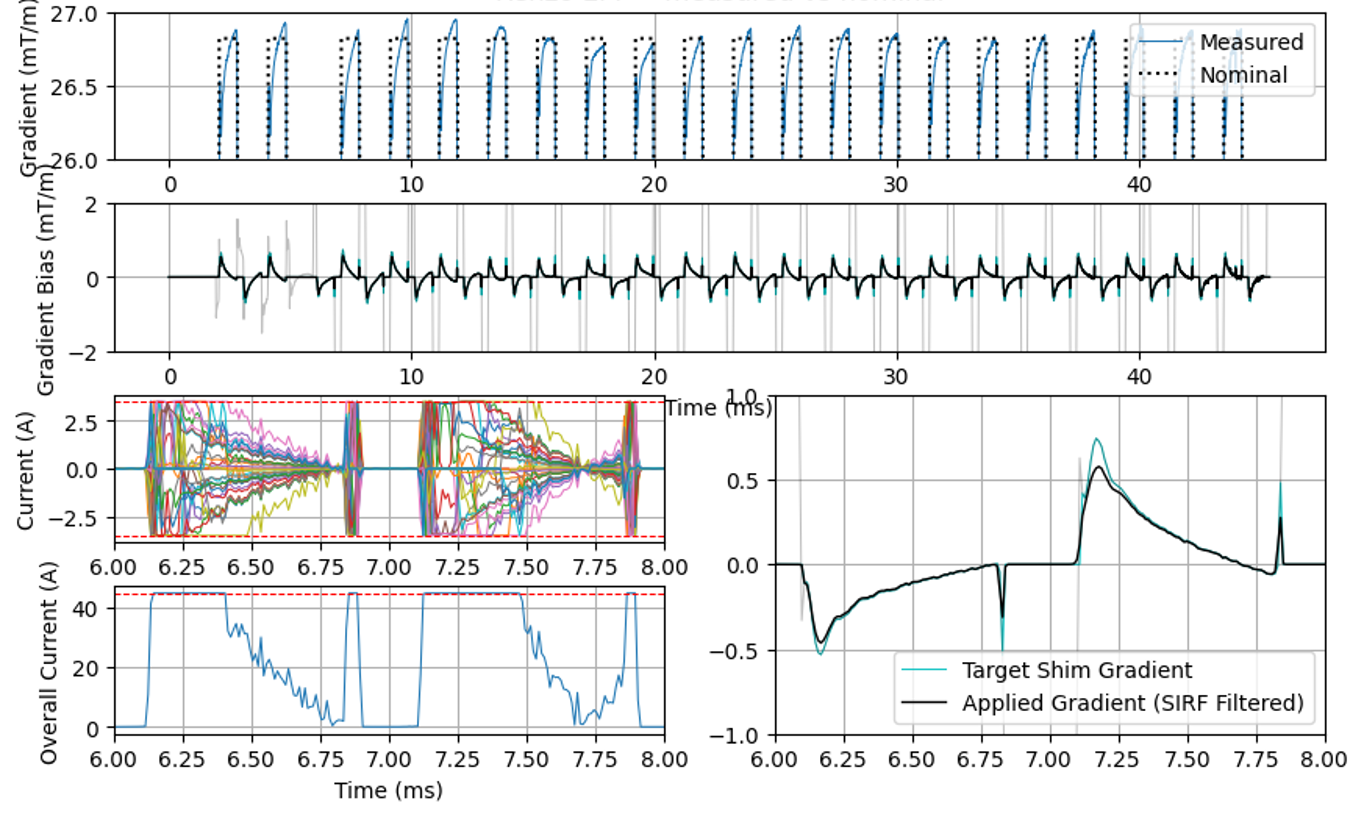
Fig 1. ACDC shim current waveforms are optimized to cancel the eddy-current-induced gradient offsets during the EPI readout.
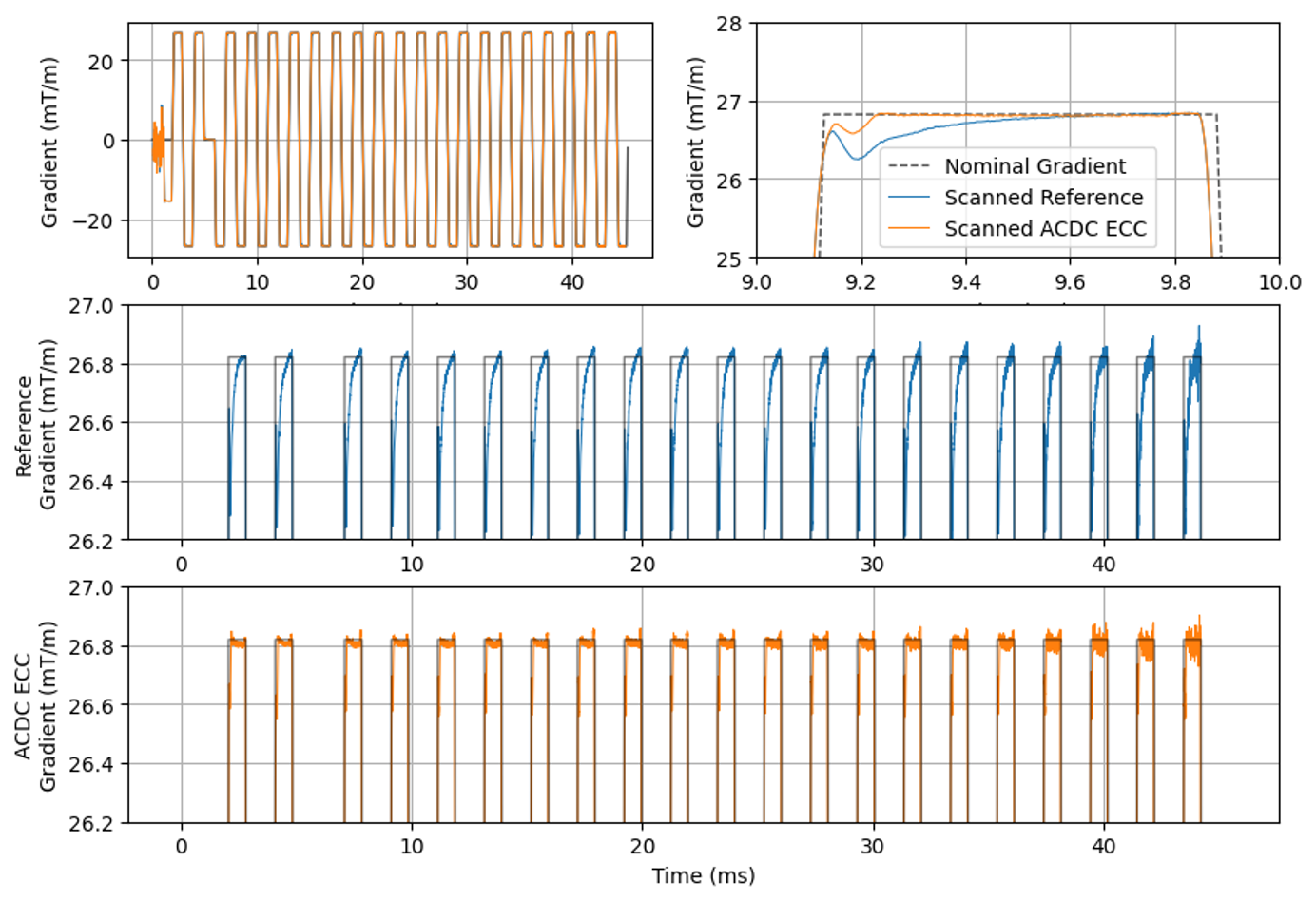
Fig 2. EPI frequency encoding gradient waveforms $G_x(t)$ were measured with and without ACDC compensation. ACDC dynamically cancels the eddy-current-induced exponential curve in the gradient waveform, restoring the intended trapezoidal shape.
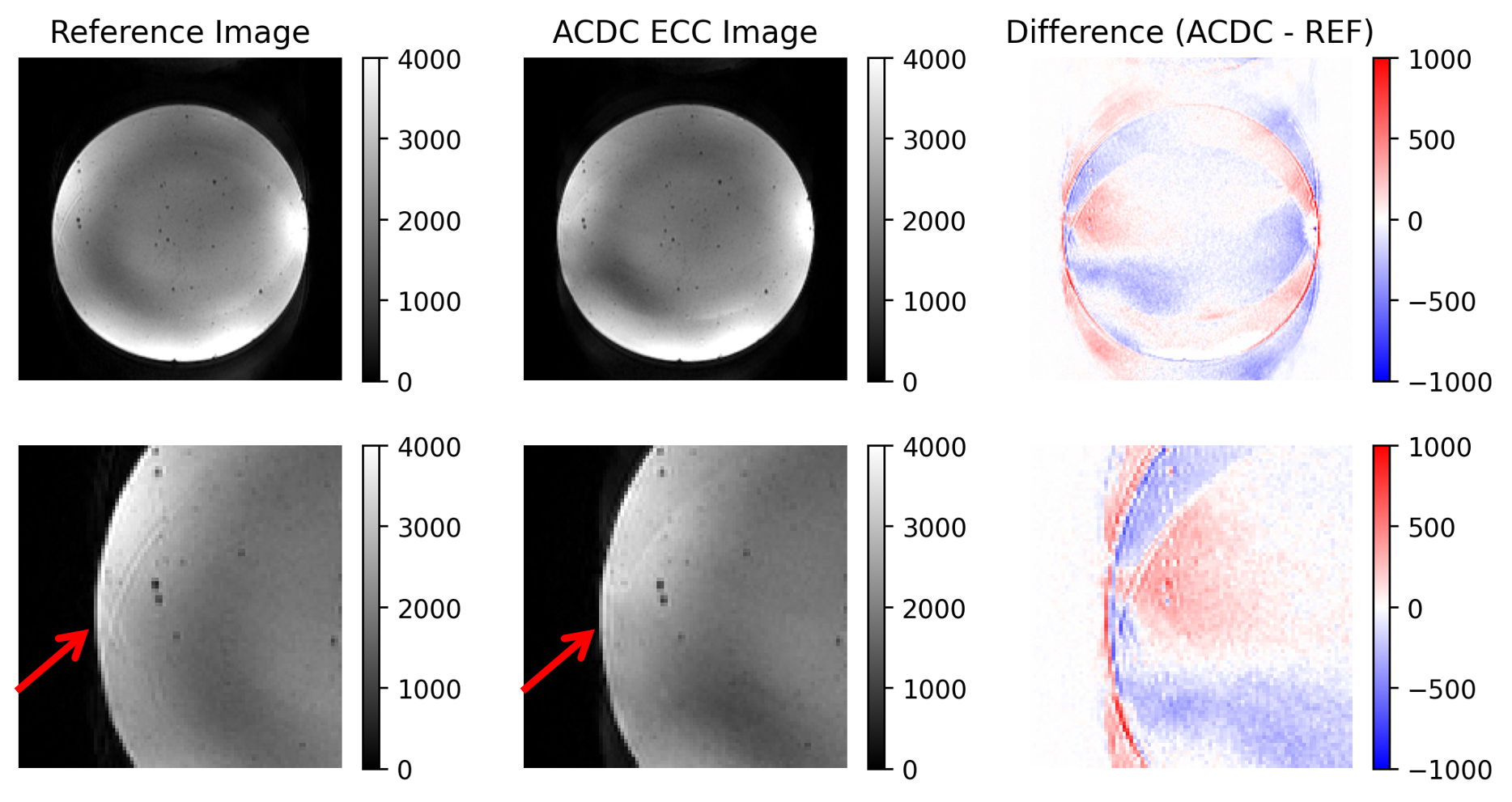
Fig 3. EPI images acquired with and without ACDC compensation. Third-order shim were unplugged in this experiment to prevent the influence of Fuzzy Ripple artifacts. The high-frequency edge ghosts (marked out by red arrow) are successfully suppressed and the image quality is restored with ACDC compensation.
2. Concomitant Field Correction: Diffusion Artifacts
The Problem
Diffusion bSSFP (balanced steady-state free precession) sequences combine diffusion weighting with the high SNR efficiency of bSSFP. However:
- The bSSFP steady state is exquisitely sensitive to off-resonance phase cumulation during the scan, producing characteristic banding artifacts
- Diffusion gradients introduce concomitant fields that shift the local resonance frequency, resulting in second-order spatially varying $\Delta f$ across the imaging volume. Unlike the linear terms, concomitant fields cannot be refocused by the bipolar gradient waveform, introducing a cumulative second-order phase bias that varies with diffusion direction.
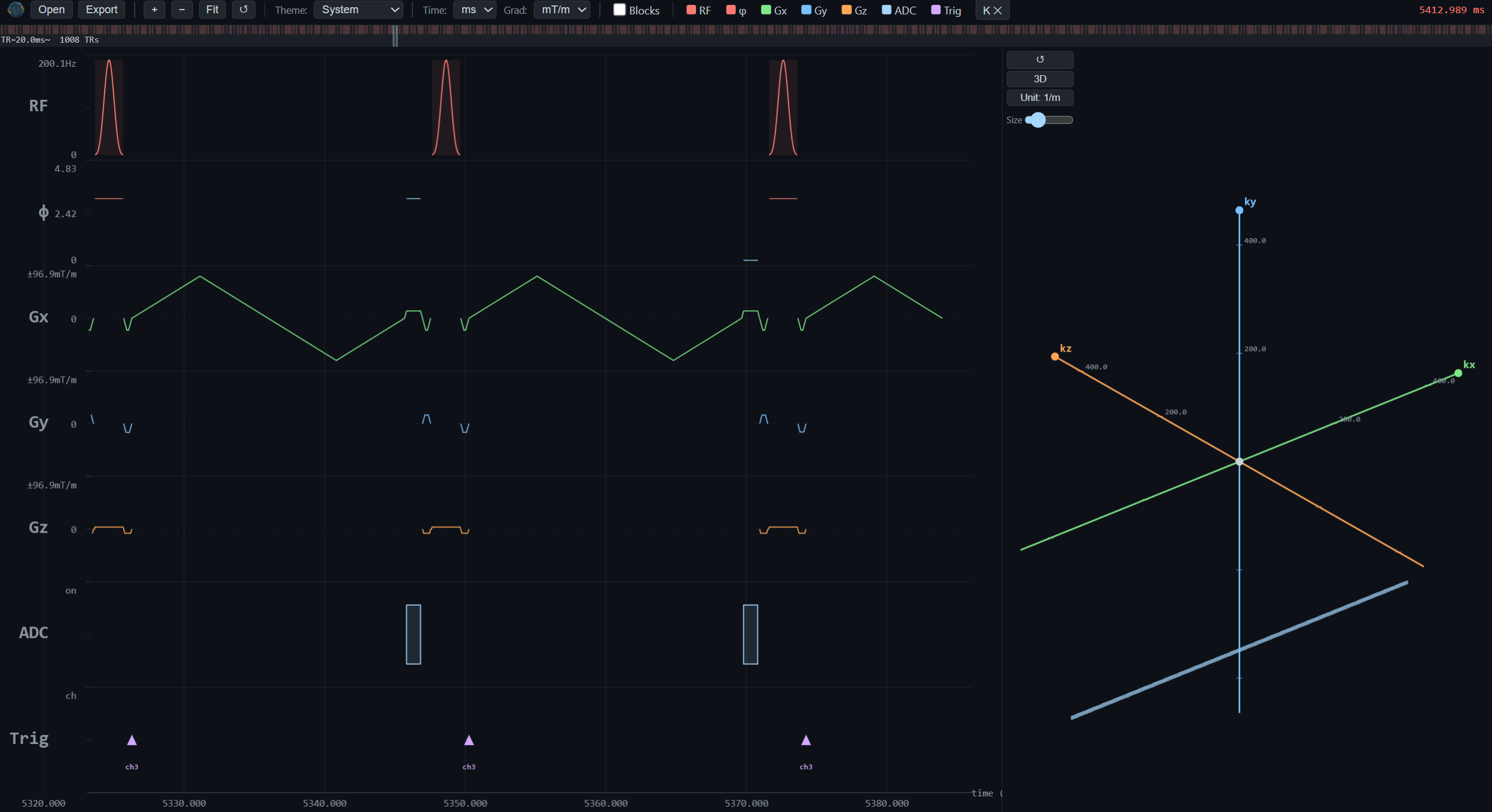
Fig 4. Pulse sequence diagram of diffusion bSSFP.
The ACDC Solution
The ACDC array can provide dynamic, diffusion-direction-dependent concomitant field compensation:
- For each diffusion direction, pre-compute the concomitant field $\Delta B_c(\mathbf{r}, t)$ from the diffusion gradient waveforms
- Optimize a per-direction shim current waveform that cancels $\Delta B_c$ during the diffusion preparation
- During the bSSFP readout, optionally switch to a static shim optimized for the average $B_0$ offset in the imaging volume
Preliminary Results
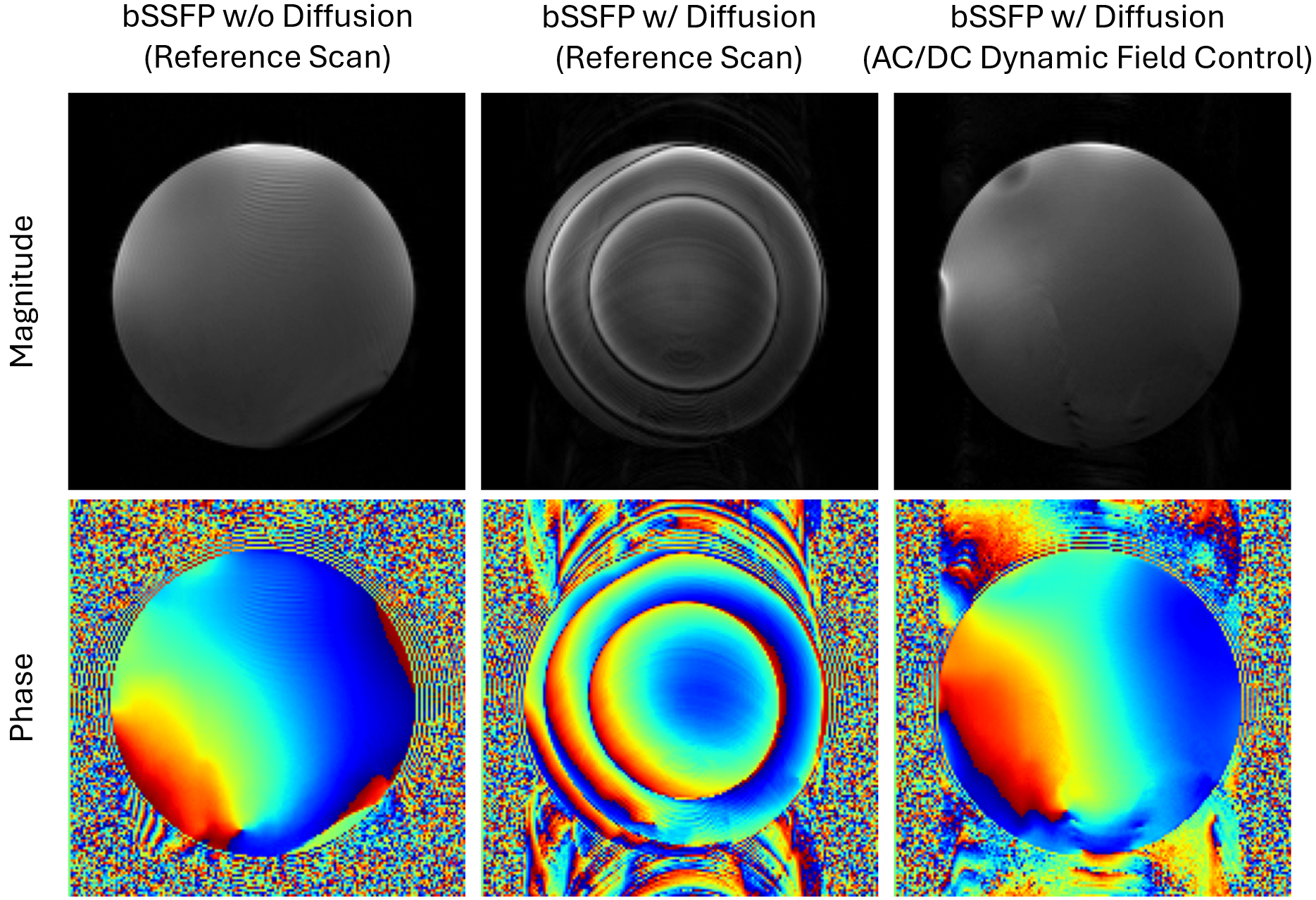
Fig 5. Diffusion bSSFP images acquired with and without ACDC concomitant field compensation. Circular banding artifacts caused by the z-direction concomitant field ($x^2 + y^2$ term) are successfully suppressed by prospective AC/DC concomitant fieldcompensation.